

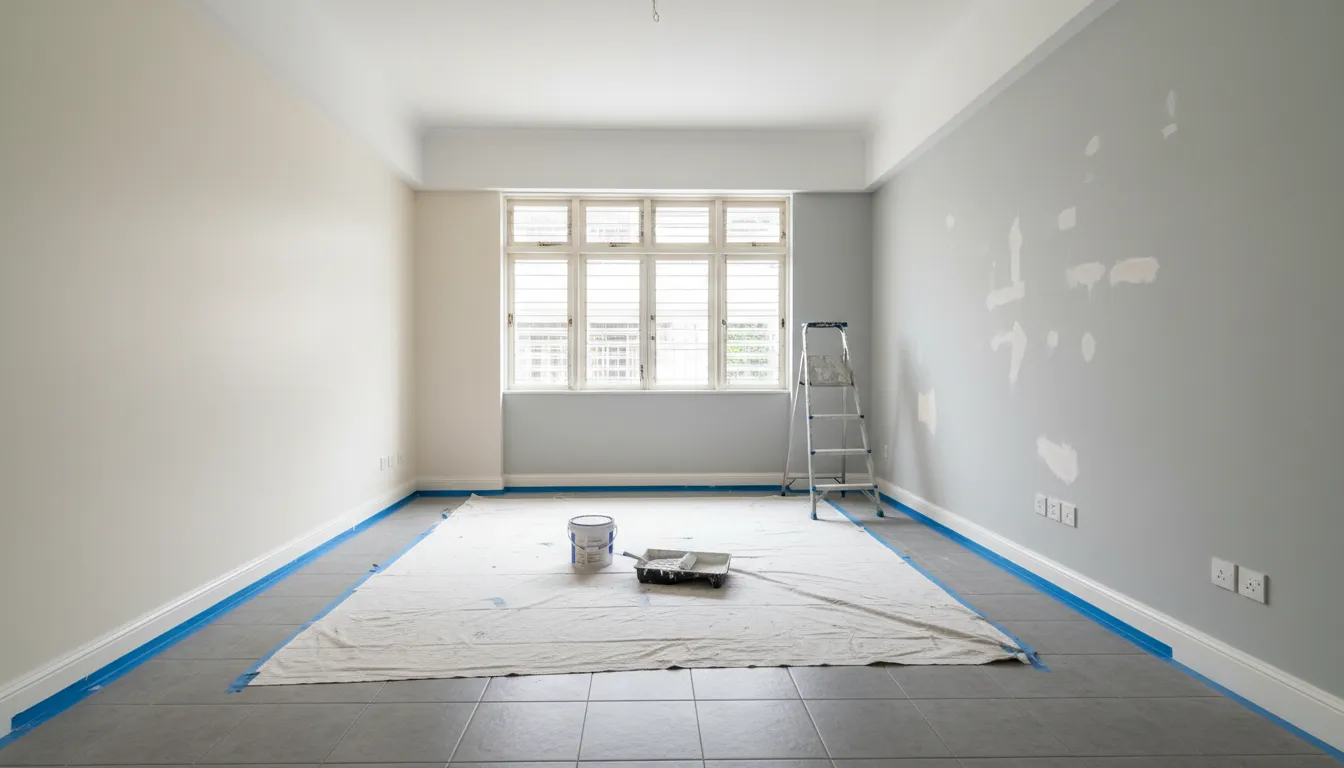
The painting is the quick part. The coats go on in hours. What stretches a job from a couple of days to a week or more is everything before the first coat: wet plaster, mould, spalling, and how much furniture is in the way.
Here's where the time actually goes, so you can plan your move-in or your nights away around it.
The short answer
Paint dries fast in our weather. A common interior paint like Nippon's Vinilex 5000 is dry to the touch in half an hour and ready for its next coat in about 2 hours. The sealer underneath is the slow coat, at about 5 hours for Nippon's wall sealer.
So one wall that needs a sealer and two topcoats takes most of a working day, just from the waiting. A crew gets around that by moving from room to room while each one dries. That's why an empty flat with sound walls goes quickly.
The days pile up somewhere else. New plaster has to dry. Mould has to be treated and the wall dried again. Spalling has to be cut out and patched before anyone paints the ceiling. And every room with a bed, a wardrobe or a TV console in it takes longer than an empty one.
Your quote should say how many days the job takes and what happens on each. If it doesn't, ask.
An empty flat and a lived-in one are different jobs
In an empty flat the crew paints. Nothing to shift, nothing to cover except the floor and the switches, and every corner is in reach.
In a flat you live in, each room goes through the same loop. Furniture to the middle, covered, walls painted, furniture back. Built-in wardrobes stay where they are, so the crew cuts in around them. You'll also want to plan where everyone sleeps on the nights the bedrooms are being done.
If you're buying a resale flat or collecting a BTO, the quickest days you'll ever get are the ones before the furniture arrives. Our guide to painting before you move in covers the order to book things in.
Wet walls hold everything up
Paint on a damp wall can bubble or flake later, so nobody good paints a wall that isn't dry.
Nippon wants the wall properly dry before its sealers go on, and says fresh plaster needs about 3 days first. So if your renovation contractor finishes plastering on a Monday, a Tuesday paint date is too early. We test the wall before we start.
The same goes for the wall behind the aircon that's always a bit damp, and the bathroom ceiling. Those need the cause sorted and the wall dried before the paint goes on. Our page on primer and sealer before painting explains when a wall needs a sealer first.
Repairs come first and set the pace
Spalling is the big one in older flats. HDB says flat owners are responsible for preventing and repairing spalling concrete in their flats, and that repainting ceilings helps prevent carbonation. The repair means removing the loose concrete, treating the steel and patching the ceiling, and each layer needs time to set before paint can go over it. Our spalling concrete repair page shows what's involved.
Before you pay for it yourself, check one thing. If your flat was built up to 1997, your precinct may be in HDB's Home Improvement Programme, which pays the Essential items, including spalling repair, in full for Singapore Citizen households once the precinct is selected and votes for it. Our HIP guide explains how to find out.
Hairline cracks are quicker. Nippon's own preparation steps say to fill them with a suitable putty or filler before painting. Each one is filled, left to dry and sanded flat before the sealer goes on.
What slows a job down on the day
- You change a colour halfway through. Pick colours before the crew arrives, and look at samples on your own walls under your own lights.
- The carpentry is still going in when the painters arrive, so ask your renovation contractor whether the cabinets go in before or after the paint.
- Mould found under old paint once the surface is cleaned. It has to be treated before anything goes over it.
- Keys and access. If nobody can let the crew in at the agreed time, the day starts late.
How to keep it short
- Send us photos of the walls you're unsure about on WhatsApp before the job. Cracks, stains, damp patches, ceilings. Then the repairs are in the quote and the schedule, not a surprise on day one.
- Clear what you can. Tell us what stays.
- Ask the painter to write down the paint. We record the brand, product, colour code and batch for every address, so a touch-up a year later matches the wall.
- Look the contractor up before you sign. HDB only lets you use contractors listed in its Directory of Renovation Contractors for work in your flat, and its e-Service shows who's on it.
We reply with a quote usually within the hour during working hours, and it tells you how many days the job needs. Have a look at our HDB painting page for what we do in a flat.
When can you sleep in the room again?
Forget the touch test. The smell is what decides when the kids can go back to bed. Our guide to low-odour paint and paint smell covers how to air the room and when it's fine to sleep there.
And don't book the movers for the afternoon the painters leave. Walk the flat in daylight first. Fixing a scuff before the sofa arrives is easy. After, it isn't.
Sources
- Nippon Paint, Vinilex 5000, read 24 November 2026
- Nippon Paint, Vinilex 5170 Wall Sealer, read 24 November 2026
- Nippon Paint, Expresskote Sealer, read 24 November 2026
- HDB, Spalling Concrete, read 4 November 2026
- HDB, Background of HIP, Annex B, read 4 November 2026
- HDB, Important Information on Renovations, read 24 November 2026