

Last checked 4 Nov 2026 against the sources at the end of this page.
To paint a room, clear it and cover the floor, repair and seal the walls, then paint the ceiling before the walls. The walls get two coats, with a brush along the edges and a roller for the rest, and each coat dries before the next goes on.
Most of that is preparation, and when the preparation is right the painting takes an afternoon. This guide follows the order a painter works in an HDB flat or condo. The amounts and drying times come from the paint maker, and the rules come from HDB.
In short
- Nippon Paint's guide lists one 5-litre can of finishing paint for each HDB bedroom.
- Most of the work comes before you open the tin, when you clear the room and then fill and seal the walls.
- Give each wall coat 2 to 4 hours to dry on most Nippon wall paints, and longer when it rains.
- None of the painting in HDB's renovation guidelines needs a permit, but HDB asks you to keep DIY work between 7am and 10.30pm.
How much paint do you need for an HDB bedroom?
One 5-litre can of finishing paint does the walls of one bedroom, going by Nippon Paint's Singapore paint guide (read 4 Nov 2026), and Nippon's wall paints go on in two coats. The same guide puts the living and dining area at one can in a 3-room flat and two in a 4- or 5-room flat. All the ceilings together take three cans in a 3- or 4-room flat and four in a 5-room.
Step 1: buy the paint and tools
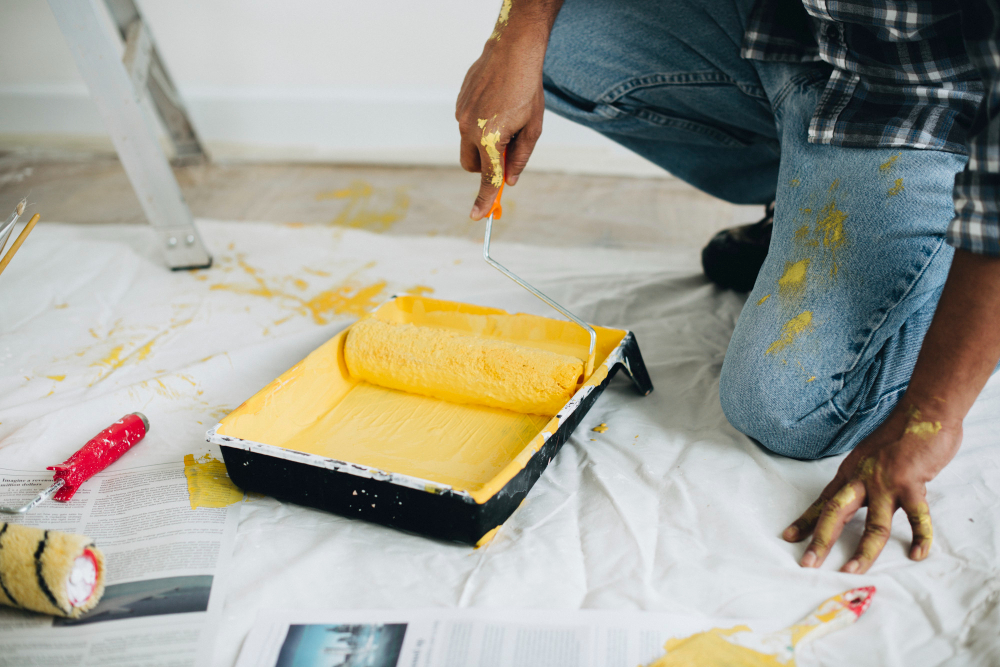
Start with wall paint from the interior range and a tin of sealer. The repairs need wall putty, a scraper and sandpaper, while masking tape, a canvas drop cloth and plastic sheet keep paint where it belongs. Then the painting kit: an angled brush, a roller with a spare sleeve, a tray, an extension pole and a ladder you trust.
Buy all the paint for one room at once so the colour matches from wall to wall, and use it straight from the tin. Nippon says its interior wall paints are water-based and need no thinning, because water weakens how well the paint covers and grips (Nippon Paint, read 4 Nov 2026). If you're not sure your wall needs sealer, our page on what sealer paint does explains when it does.
Protect the floor and furniture
Step 2: clear the room and cover what stays
Move out whatever you can carry. Push the bed and wardrobe to the middle of the room and wrap them in plastic sheet taped shut, since anything near a wall will catch drips.
Nippon's preparation checklist (read 4 Nov 2026) warns against old bed sheets, because paint soaks through fabric, and prefers a canvas drop cloth on the floor because it doesn't slide underfoot when you're up a ladder. Tape over the switches and sockets. Run tape along the window frames and the top of the skirting as well, and round the edges of any built-in wardrobe, then press it flat with a card so paint can't creep under it.
Do you need to prepare the walls first?
Yes. New paint sticks to whatever is on the wall, so dust, flakes or powder under it will lift and take the new coat with them.
Step 3: scrape and fill
Scrape off anything that has started to flake or bubble. Fill holes and hairline cracks with wall putty and leave it until it's dry right through.
A patch that's damp or keeps bubbling needs the water found first, because no paint stays on a wet wall. Our guide to why paint peels and bubbles walks through the causes.
Step 4: sand, clean and seal
Sand the filled spots flush, then give the whole wall a light sand. Old paint that's still firmly stuck can stay once it's been sanded, according to Nippon's wall prep guide (read 4 Nov 2026). Wipe the wall down with detergent and water and go over it again with clean water, and don't start the next step until it's dry to the touch.
Then rub your palm across the wall. White powder on your hand means the old paint is chalking, and the wall needs sealer before any top coat. Seal the patched spots and any bare plaster as well. Nippon notes that flats over 20 years old often need a sealer coat before a repaint, and that new HDB walls hold more moisture (Nippon Paint, read 4 Nov 2026).
Get the order right: ceiling first, door last
Step 5: paint the ceiling
Nippon's painting sequence (read 4 Nov 2026) starts at the top so that drips fall on surfaces you haven't painted yet. After the ceiling come the walls, then the windows and sills, the skirting and the door frame, with the door last of all.
Roll the ceiling in strips with the roller on the extension pole, and let the paint run a finger's width onto the wall, where the wall coat will cover it. HDB gives one more reason to do the ceiling properly: its spalling concrete guide (read 4 Nov 2026) says paint helps keep out the carbonation that rusts the steel in the slab.
How do you paint a wall without patchy marks?
Step 6: cut in the edges
Brush a band a few centimetres wide along the ceiling line and down the corners. Take it round every switch and along the top of the skirting too. Work one wall at a time, so the band is still wet when the roller reaches it.
Step 7: roll the wall
Load the roller and roll off the excess on the tray. Nippon suggests an N or upside-down N stroke, with each pass overlapping the last (Nippon Paint, read 4 Nov 2026). Finish the whole wall before you stop for a break, because paint that dries halfway across leaves a line.
Your first coat will probably look patchy. That's normal after one pass, and the second coat evens it out.
How long does each coat take to dry in Singapore?
Step 8: give it a second coat
Nippon's paint guide gives two coats for its wall paints, such as Vinilex 5000 and EasyWash, with 2 to 4 hours between them. When the wait is up, cut in and roll again exactly as before.
The Meteorological Service Singapore (read 4 Nov 2026) says relative humidity is above 90% just before sunrise and falls to around 60% on an afternoon without rain. In a long spell of rain it can reach 100%. Damp air slows drying, and Nippon warns it can raise bubbles in fresh paint. So paint in the afternoon with a window open and a fan on, and if a corner still feels tacky when the time's up, give it longer.
Do you need a permit to paint your HDB flat?
No. None of the painting listed in HDB's building works guidelines (read 4 Nov 2026) needs a permit, from spray painting walls to painting the household shelter. HDB's renovation information page (read 4 Nov 2026) asks you to keep DIY work between 7am and 10.30pm. It also lists painting the common corridor walls and ceilings as work owners can't do.
The household shelter has rules of its own. You may paint its walls and door, but HDB says to leave the door notice, the bolts and the door seal unpainted. Strip the old paint from the door and frame before you repaint, and let the new coat dry before you shut the door, or it will stick to the frame. In a condo, check the management office's renovation rules before you start.
Clean up, and keep paint out of the drain
Step 9: clean the tools and deal with the leftovers
Scrape what's left on the brush and roller back into the tin, then wash them in warm soapy water (Nippon Paint, read 4 Nov 2026). Never pour paint down a sink, toilet or floor trap.
Nippon's disposal guide (read 4 Nov 2026) says a can under a quarter full can be left open somewhere airy until the paint sets solid, then thrown out with household rubbish. Oil-based paint and thinners are hazardous waste and go to a toxic industrial waste collector on NEA's list. Keep one sealed can for touch-ups, and write the room and the colour code on the lid.
Paint it yourself, or hire a painter for this one?
A bedroom with sound walls is a good first job. A painter is the cheaper choice when doing it yourself would mean doing it twice: when the wall needs more than putty, with cracks that reopen, loose plaster, or brown stains and bulges on the ceiling that may be spalling concrete. The same goes for damp or mould that keeps coming back, a whole flat with every ceiling overhead, and high ceilings or a maisonette stairwell where the ladder work gets risky. Condo jobs add management office forms and deposits.
Our team plasters, repairs spalling and paints, so the wall is fixed before the first coat goes on. We handle the MCST permits on condo jobs. We also record the paint brand, product, colour code and batch for your address, so a touch-up years later matches.
Sources
- Nippon Paint Singapore, How to paint a room: paint guide, read 4 Nov 2026
- Nippon Paint Singapore, Getting the order right, read 4 Nov 2026
- Nippon Paint Singapore, Cleaning up, read 4 Nov 2026
- Nippon Paint Singapore, Should you paint the house or hire painters to do it?, read 4 Nov 2026
- Nippon Paint Singapore, How to prepare your home for painting: a room-by-room checklist, read 4 Nov 2026
- Nippon Paint Singapore, Step-by-step guide to prepping your wall for a repaint, read 4 Nov 2026
- Nippon Paint Singapore, 6 easy steps to make your DIY paint job last longer, read 4 Nov 2026
- Nippon Paint Singapore, Can I dilute the paint before painting?, read 4 Nov 2026
- Nippon Paint Singapore, Is uneven application normal for water-based sealer?, read 4 Nov 2026
- Nippon Paint Singapore, Will I need to remove all the mould before painting over it?, read 4 Nov 2026
- Nippon Paint Singapore, Paint disposal and storage, read 4 Nov 2026
- HDB, Building works guidelines, read 4 Nov 2026
- HDB, Important information on renovations, read 4 Nov 2026
- HDB, Spalling concrete in HDB flats: prevention and repair, read 4 Nov 2026
- Meteorological Service Singapore, Climate of Singapore, read 4 Nov 2026